Auto Predictions: Check Your Forecast
Make your next auto prediction measurable. Define the event, record your confidence, and compare your forecast with the result.
Your forecast notebook
Auto forecast score calculator
Enter the probability you recorded before a race or vehicle announcement. Then select the confirmed outcome of your exact question. This tool calculates an error score for that resolved prediction. It does not retrieve event results.
Enter a probability from 0 to 100. An unresolved question cannot receive a score.
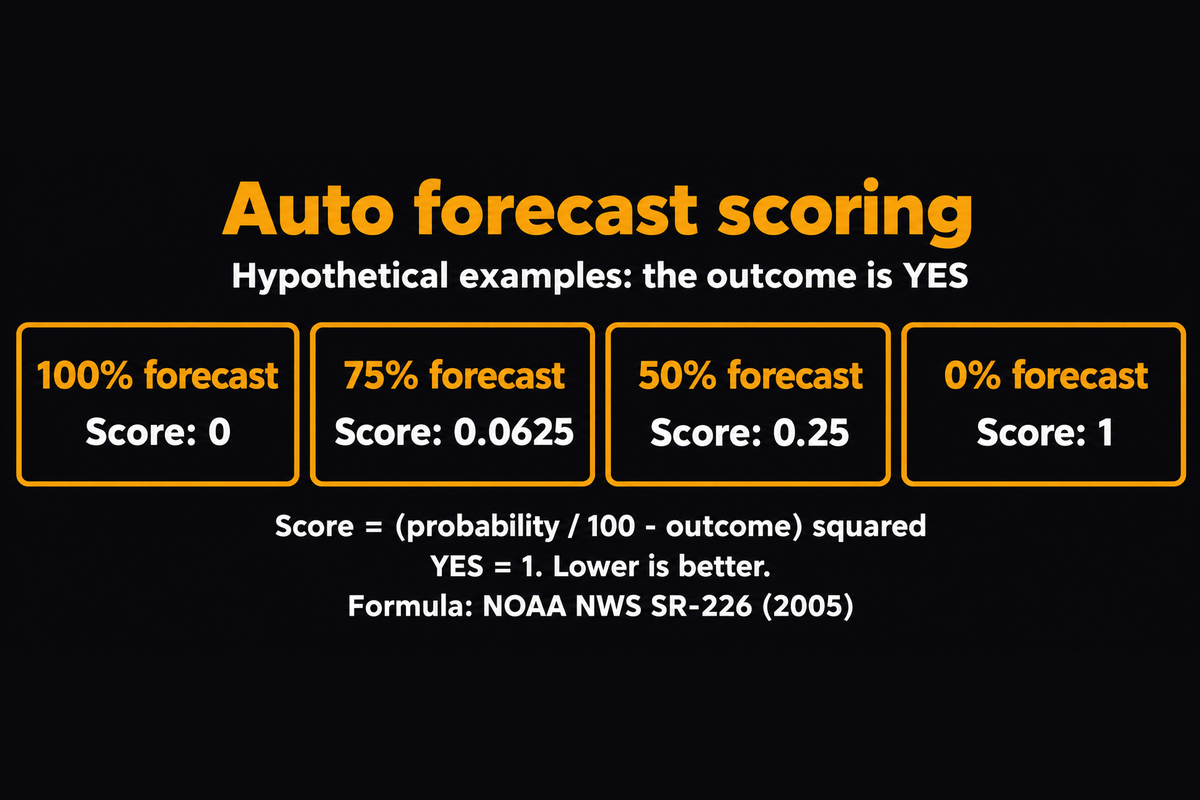
Method: score = (probability ÷ 100 − outcome)². YES is 1; NO is 0. NOAA National Weather Service memorandum SR-226 (2005) describes this binary Brier score. Scores range from 0 to 1; lower is better. For several forecasts, average their scores.
The calculator sends no inputs and saves no history. Keep your own record before you leave. The example values are hypothetical.
Define the finish line before the forecast
An auto prediction needs a question that another person can resolve. Start with the event, the deadline, and the evidence you will accept. Replace words such as “soon” or “successful” with a condition you can check. Keep the original wording beside your probability.
For a race, name the series, venue, session, and driver. Specify whether you mean a qualifying position or a race result. Choose the official classification that will settle the question. Record how you will handle a postponed event or a later change to the published result.
A useful practice question is: “Will my chosen driver finish on the podium in the official final classification?” This is a question template, not a current race forecast. Add the event details before you assign a probability. Do not change the condition after you learn the outcome.
Give an EV launch a clear meaning
For an electric vehicle (EV), write separate questions about a reveal, orders, production, and customer deliveries. Specify the model, country, and deadline. Decide whether your question requires a manufacturer statement or another named record. Save that evidence when you resolve the question.
For example, ask whether a manufacturer will confirm customer deliveries in a chosen country before your deadline. Do not count an order page as delivery evidence if your question concerns deliveries. Mark the question unresolved if the available statement does not meet your original condition.
Keep a short note about what could change your estimate. A new announcement can justify a new forecast, but it should not replace the old record. Date each estimate so you can compare the evidence available at different stages.
Separate driver assistance from automation
A technology forecast should describe the driving task and the operating area. Specify whether a demonstration or a service available to customers will satisfy the question. Avoid using a feature name as your only definition of capability.
The National Highway Traffic Safety Administration (NHTSA), in its Automated Vehicle Safety guide checked in 2026, distinguishes Level 2 assistance from Level 4 automation. At Level 2, the driver remains attentive and responsible while the system assists with steering and acceleration or braking. At Level 4, the engaged system handles driving within limited service areas.
Use those distinctions to make a narrow question. Record where the system must operate and who must supervise it. Keep questions about technical capability separate from questions about availability. A forecast about an announcement needs different evidence from a forecast about an operating service.
Keep a record you can review
- Write the question and probability before the event.
- Save the official evidence when the question resolves.
- Use the original probability to calculate the score.
Compare forecasts about the same question with the same deadline. Keep race forecasts and delivery forecasts in separate groups. Record the reason for each estimate so your later review covers your reasoning as well as the outcome.
A hypothetical 75% forecast scores 0.0625 for YES and 0.5625 for NO. A 50% forecast scores 0.25 for either outcome. These examples follow the formula above. They do not measure this site's past performance.
Review all your resolved questions, including the difficult ones. Keep unclear questions outside the score until you can resolve them consistently. Use your notes to improve the next question without rewriting the record of the previous prediction.
Sources: NOAA National Weather Service, SR-226, November 2005, section IV; NHTSA, Automated Vehicle Safety, checked 2026. Page reviewed: 2026-10-28.